
Understanding Your Outboard Motor's Cooling System | PWCParts.com
Posted by PWCParts Team on May 12th 2026
Understanding Your Outboard Motor's Cooling System | PWCParts.com
Your outboard motor runs hot — combustion temperatures inside the cylinders can exceed 2,000°F. Without a properly functioning cooling system, an engine that produces that kind of heat would destroy itself within minutes. Yet for most boat and PWC owners, the cooling system gets almost no attention until something goes catastrophically wrong. Overheating accounts for a significant percentage of outboard failures, and the vast majority of those failures trace back to one neglected component: the water pump impeller. If you ride saltwater, freshwater, or anything in between, understanding how your outboard's cooling system works — and how to maintain it — is essential knowledge.
How Does an Outboard Motor's Cooling System Work?
Unlike car engines that use a closed-loop system with a radiator and coolant, outboard motors use an open-loop raw-water cooling system. That means the engine draws water directly from the body of water you're riding on, circulates it through the engine to absorb heat, and then expels it out the exhaust. There's no coolant reservoir to check, no radiator to flush — but that simplicity comes with its own set of vulnerabilities.
The system works like this: a water pump in the lower unit pulls water up through an intake screen. That water travels up the driveshaft housing through a series of passages, flows around the cylinders and cylinder head to absorb combustion heat, passes through a thermostat that regulates operating temperature, and finally exits through the exhaust relief port — that telltale "pee stream" that tells you the cooling system is working. No pee stream means no water flow, which means overheating is imminent.
The Water Pump and Impeller: Heart of the Cooling System
The water pump is driven by the driveshaft and contains a rubber impeller — a wheel with flexible vanes that flex against an off-center housing to create suction and push water through the system. This impeller is the single most maintenance-critical component in the entire cooling system, and it has a well-deserved reputation for causing problems when neglected.
Rubber impeller vanes take a beating. They flex thousands of times per minute, they're exposed to sand, grit, and debris, and when the engine is stored without running, the vanes can take a "set" — meaning they dry out and curl in one direction permanently. A vane that's taken a set can no longer generate proper suction, and water flow drops dramatically. The engine may technically run, but it runs hot, and hot running accelerates wear across every component in the powerhead.

The fix is straightforward: replace the impeller on a regular maintenance schedule. For most outboards, the recommendation is every 100 hours or once per season — whichever comes first. If you're running saltwater regularly or storing the motor for extended periods without flushing, err on the side of more frequent replacement. The Quicksilver Water Pump Impeller for Mercury 30-350HP 4-Stroke and 75-115HP OptiMax (43026T2) is a direct OEM replacement that fits a wide range of Mercury outboards — the kind of part you should have on hand before you need it, not after.
The Thermostat: Regulating Engine Temperature
Once water is flowing through the engine, the thermostat controls how much heat the engine retains. Outboard thermostats work on the same principle as automotive ones: a wax pellet inside the valve expands when it reaches a set temperature, opening the valve and allowing hot water to exit while cooler water enters. Most outboards are designed to run between 140°F and 160°F — warm enough for efficient combustion and proper oil viscosity, but cool enough to prevent damage.
A thermostat that's stuck open runs the engine too cool, which causes incomplete combustion, carbon buildup, and increased fuel consumption. A thermostat that's stuck closed is far more dangerous — it prevents the engine from shedding heat at all, leading to rapid overheating. Thermostats rarely fail without warning: you'll often see temperature fluctuations on your gauge, or the engine will run unusually hot or cold before the thermostat quits entirely. Replace thermostats as part of any scheduled water pump service — they're inexpensive and the labor is already done.
Warning Signs Your Cooling System Is Failing
Your outboard will usually tell you something is wrong before it overheats to the point of damage. Watch for these warning signs:
- No pee stream or weak water flow from the exhaust relief port — the most obvious indicator of a failing impeller or blocked water intake.
- Rising temperature gauge — if your gauge climbs above normal operating range, shut the engine down immediately and investigate.
- Temperature warning alarm — most modern outboards have an audible alarm that activates when coolant temperature exceeds safe limits. If it goes off, kill the engine.
- Steam from the engine compartment — a sign that coolant is boiling somewhere in the system.
- Loss of power — many modern engines have limp-home mode that reduces RPM automatically when they detect overheating.
If you see any of these signs, don't push through to the dock. Continued operation of an overheating outboard can warp the cylinder head, score cylinder walls, or seize the engine entirely — repairs that can cost thousands of dollars.
Scheduled Cooling System Maintenance: What's Involved
A proper cooling system service at 100 hours (or annually) should include the water pump impeller, the thermostat, the thermostat housing gasket, and all water pump housing gaskets and O-rings. Doing these as a group makes sense because the labor to access the impeller also gives you access to the thermostat, and piecemealing the job means you'll be back in the lower unit sooner than necessary.

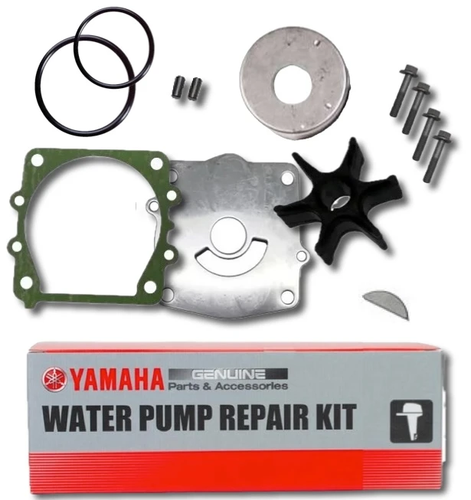
For Yamaha F115 owners, the Yamaha F115 100-Hour Maintenance Kit bundles the OEM water pump rebuild kit, thermostat, fuel filters, spark plugs, trim tab, anodes, and lower unit gear lube into one package — everything you need for a comprehensive service at one price. Using OEM components matters here: aftermarket impellers sometimes use rubber compounds that are softer than spec, which sounds like a benefit until the vanes tear apart inside your water pump housing and send debris through the cooling passages.
Flushing After Saltwater Use
Salt is relentless. Every time you run your outboard in saltwater, salt crystals deposit inside the cooling passages, water pump housing, and exhaust system. Over time, those deposits restrict water flow just as effectively as a failed impeller — but more insidiously, because the restriction builds gradually and may not trigger a sudden overheating event. Instead, you just run a little hotter than you used to, stress the engine slightly more than before, and shorten its service life by years.
Flush your outboard with fresh water after every saltwater outing, without exception. Use flush muffs that seal around the water intake and let the engine idle for at least five minutes — long enough for fresh water to reach every passage in the system. This one habit, consistently applied, is the single best thing you can do to extend the life of your cooling system and your engine.
Frequently Asked Questions
How do I know if my outboard impeller needs to be replaced?
The most obvious sign is reduced or absent water flow from the exhaust pee hole. If you're also seeing elevated operating temperatures or the engine is running hotter than usual, the impeller is a prime suspect. Even without visible symptoms, impellers should be replaced every 100 hours or once per season — rubber degrades with time and heat exposure regardless of how many hours are on the engine.
Can I run my outboard without a thermostat?
Technically yes, but you shouldn't. Without a thermostat, the engine runs too cool — which causes incomplete combustion, increased carbon deposits, accelerated cylinder wear, and reduced fuel efficiency. Modern outboards are calibrated to run within a specific temperature range, and removing the thermostat takes it out of that range permanently. Always replace a failed thermostat with the correct OEM unit for your engine model.
What happens if I ignore an overheating outboard?
Continued operation of an overheating engine can cause head gasket failure, a warped or cracked cylinder head, scored cylinder walls, and in severe cases, a seized engine. Any of these repairs will cost significantly more than the impeller or thermostat that caused the problem in the first place. The moment your temperature alarm sounds or your gauge climbs into the red, shut the engine down and trailer home — it's always the right call.